Making Hospital at Home work in care homes
Summary
New research shows strong support for Hospital at Home among care home staff, but practical barriers can limit access and effectiveness. Remote Patient Monitoring can support ongoing monitoring between visits from Hospital at Home teams, provided it is connected to clear clinical oversight and escalation pathways.
Hospital at Home in care homes can enable older people to receive hospital-level care in familiar surroundings when it is safe and right to do so. For residents, this can make a significant difference to their experience of care. Making that possible consistently, however, requires more than simply having a Hospital at Home service available.
New research led by the University of Oxford and published in Age and Ageing explores care home staff experiences of Hospital at Home and highlights both the benefits they see for residents and the practical barriers that can prevent these services being used effectively. The findings reinforce an important challenge for health systems looking to deliver more care outside hospital: making it work requires the right support around the resident.
The case for care in familiar surroundings
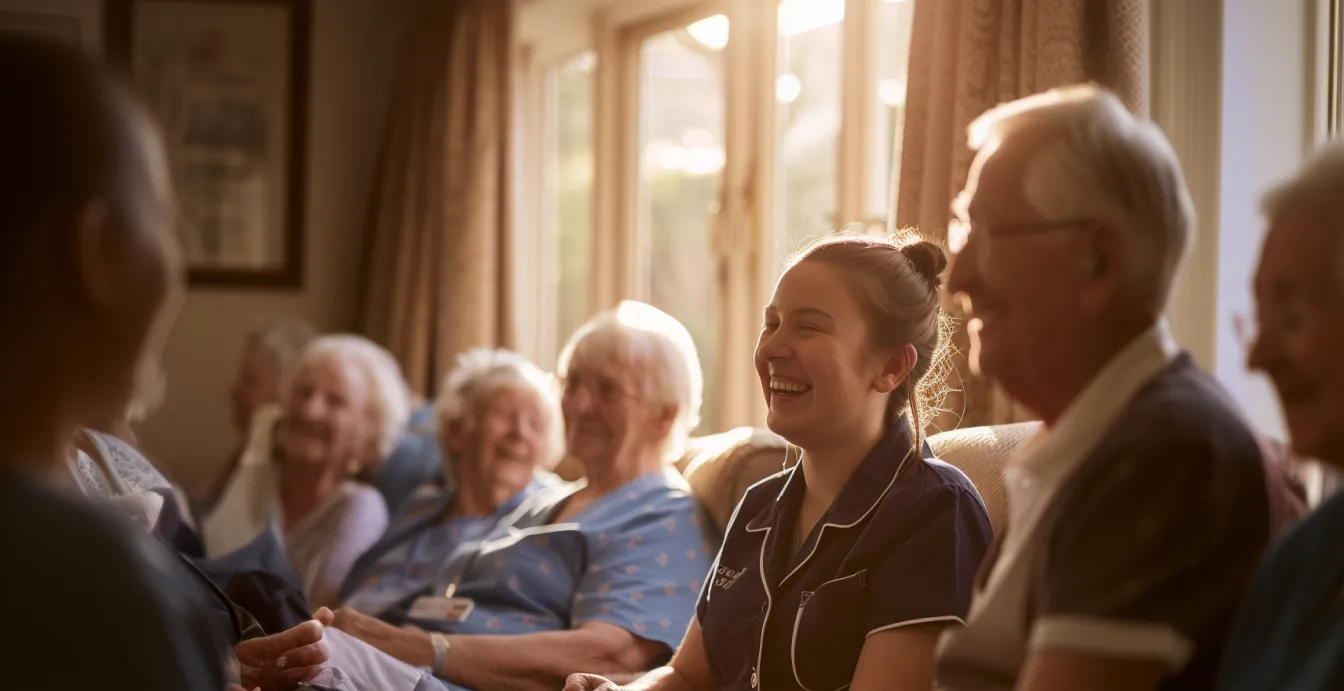
For older people living with frailty, dementia or multiple long-term conditions, a hospital admission can be particularly disruptive. Care home staff involved in the study described challenges including distress, communication difficulties and physical or cognitive deterioration following admission to hospital.
Hospital at Home can offer an alternative by bringing hospital-level care to the resident, allowing them to remain in familiar surroundings with care home staff who already know them and understand their needs.
The research found strong support for this approach, with 69% of staff surveyed preferring a model involving admission avoidance or early supported discharge through Hospital at Home. Yet hospital admission remained the most commonly reported pathway, highlighting a gap between preference and practice.
Making Hospital at Home pathways work
The study found several practical barriers to wider use of Hospital at Home, including workforce capacity, geographical coverage, restricted operating hours and inconsistent referral routes. How care homes accessed services also varied, with some able to refer residents directly while others needed to go through a GP.
Access to digital monitoring equipment and the way services were delivered also differed. When a resident begins to deteriorate, these variations can affect who staff contact, how concerns are escalated and how quickly clinical support can be accessed.
Clinical teams also need sufficient information to assess the resident and make confident decisions about their care. Without clear routes between teams, opportunities to provide appropriate care within the care home may be missed.
The role of Remote Patient Monitoring
The study also highlights the role care home staff play between Hospital at Home visits, with staff resuming responsibility for monitoring residents and escalating concerns.
Remote Patient Monitoring can form an important part of that pathway. By capturing physiological observations and other health information within the care home, RPM can give clinical teams greater visibility of a resident's condition and help identify deterioration earlier. It can also provide clinicians with additional information to support decisions about whether a resident needs further assessment, intervention or escalation.
Monitoring alone is not enough. A reading or notification only becomes useful when the right person can interpret it, understands what action is required and has a clear route for responding. Effective Virtual Care, including Virtual Wards / Hospital at Home, therefore needs to connect technology with clinical oversight, clear escalation pathways and the practical delivery of care.
The same applies more widely to Technology Enabled Care. Louise Murray, Kensa Health's Managing Director for Virtual Care and Analytics, explores this further in Technology Enabled Care That Does More Than Monitor, drawing on her clinical background and extensive experience in Remote Patient Monitoring and Virtual Care.
Connecting health and social care around the resident
Care home residents do not experience health and social care as separate systems. Their support may involve care home staff, GPs, community services, Hospital at Home teams, acute services and other health and care professionals.
Each part of that pathway may work well individually, but problems arise when information, responsibility or time is lost between them. The study highlights the importance of stronger digital integration and information sharing across health and social care as part of addressing this.
For Hospital at Home in care homes to work effectively, those services need to work together around the needs of the resident.
At Kensa Health, our approach to Virtual Care reflects the need for more connected care. Remote monitoring can give clinical teams greater visibility of people outside traditional care settings, while configurable pathways and notifications can support appropriate escalation as needs change.
Hospital at Home will not be appropriate for every resident or every episode of deterioration, and acute hospital care will remain necessary where someone's needs require it. However, the study shows clear support among care home staff for greater use of Hospital at Home when residents can be safely cared for in their care home.
Delivering that consistently means addressing the practical barriers identified in the research, including referral routes, service availability, monitoring, information sharing, workforce capacity and training. Technology has a role to play, but it needs to sit within a pathway that works for care home staff, clinical teams and, most importantly, residents.
Interested in delivering more care safely outside hospital?
Find out more about Kensa Health's Virtual Care solutions and how we support health and care teams to build effective care-at-home pathways.
Alternatively, get in touch with our Virtual Care team by completing our contact form or calling 0330 380 2236. We'd be delighted to discuss how Kensa Health can support your organisation.
Reference
Nwolise, C., McKelvie, S., Russell, S. and Peters, M. (2026). ‘Hospital at Home for older residents with physical deterioration: care home staff experiences’. Age and Ageing, 55(8), afag236. https://doi.org/10.1093/ageing/afag236
.png)


.webp)