Fixing Flow Beyond the Emergency Department Front Door
Summary
The Challenge: Emergency department pressure is highly visible, but the main constraint often sits further along the pathway. NHS South East data showed that admitted patients represented a smaller share of Type 1 ED attendances, yet accounted for a disproportionate share of modelled ED capacity.
The Intervention: Health Insights was used to examine demand, capacity and patient flow across the first 72 hours of care, looking beyond ED performance to admitted patient flow, SDEC, acute medicine and onward pathways.
The Result: The analysis showed why improvement planning needed to extend beyond ED breach management. For systems under urgent care pressure, the key question is not only how quickly patients move through ED, but how effectively admitted patients flow through the wider acute pathway. The root cause of congestion will vary across providers. By analysing population rates and pathway data, we can identify whether overnight admissions could be reduced patient flow improved, helping to reduce corridor care for vulnerable patients.
This Health Insights in action example is based on modelling undertaken to support urgent and emergency care planning.
Health Insights in Action
Pressure in an emergency department is highly visible. Crowding, long waits and ambulance handover delays naturally draw attention towards the ED front door.
But arrival volumes and ED capabilities do not explain the whole problem.
Health Insights is used across the NHS South East region to support regional and system-level analysis of urgent and emergency care. In June 2025, the 72-hour model was used to analyse urgent care data from across the South East, examining how different patient groups consumed capacity within Type 1 emergency departments and the admitted pathway.
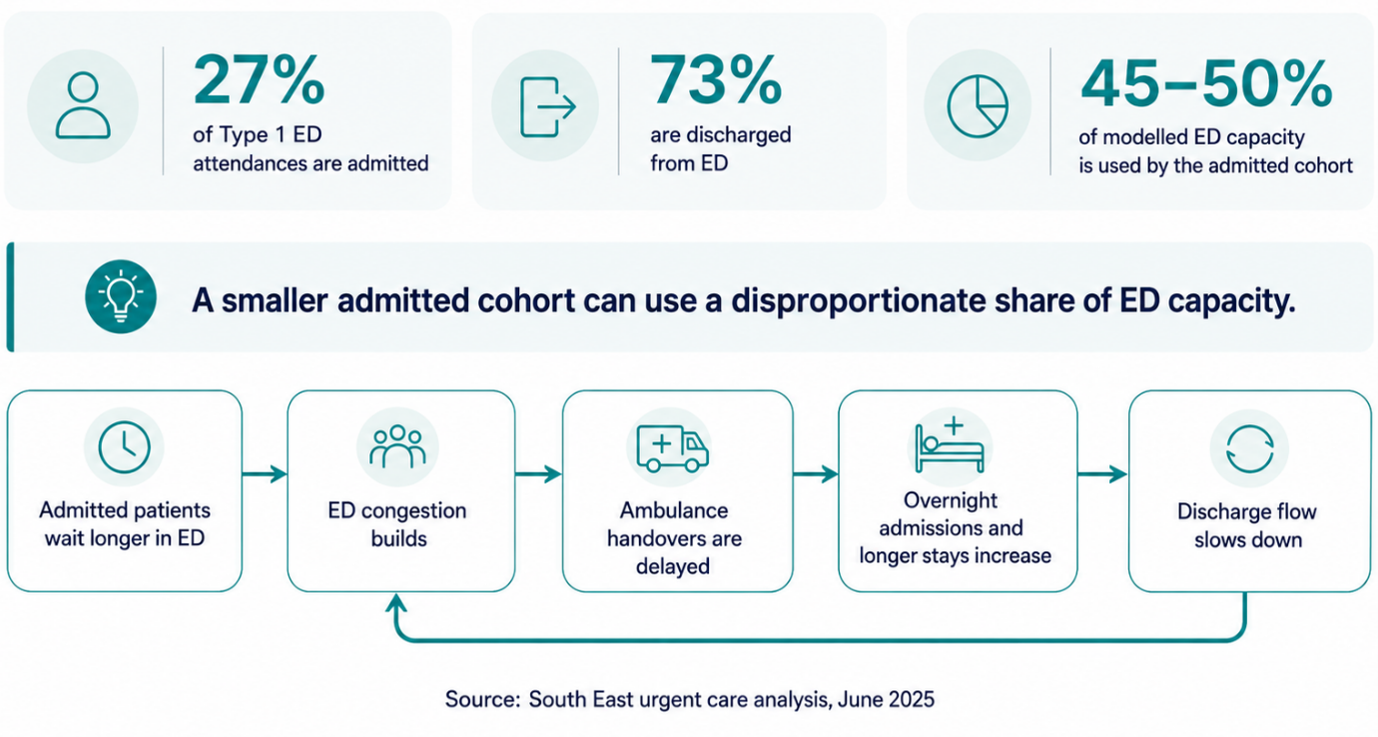
The analysis showed that although only 27% of Type 1 ED attendances resulted in admission, these patients accounted for around 45% to 50% of modelled ED capacity because they remained in the department for longer.
This pointed to a different improvement question.
Rather than looking only at how quickly all patients move through ED, systems need to understand what happens to patients who require diagnostics, admission, acute physician input, specialty review or onward care. Delays in those next steps can restrict ED capacity even when most people attending are assessed and discharged.
The 72-hour model was developed to examine that connected pathway. It brings together demand, capacity and patient flow across ED, SDEC, acute medicine and admitted care, allowing leaders to identify the main constraint and test how different interventions could affect the wider system.
What the Data Showed
The analysis highlighted a flow issue that many urgent care systems will recognise.
Most Type 1 ED attendances were discharged from ED. However, the admitted cohort stayed longer and consumed a much larger share of capacity. That means performance pressure cannot be understood from attendance volume alone.
The model also showed why this matters for frail and older patients. Long waits in ED can increase the risk of deconditioning, delirium, overnight admission and longer length of stay. Delays in decision-making can therefore affect both operational performance and patient outcomes.
This is where the first 72 hours become critical. Decisions made during this period influence admission, onward flow, length of stay and a patient’s ability to return home safely.
How the Model Supports Planning
The 72-hour model does not stop at showing where pressure exists.
It helps leaders compare the current pathway with a ‘do nothing’ counterfactual, then test how different interventions could affect flow, capacity and risk before committing operational resources.
The process is designed to support practical urgent care planning:
- explore the data
- identify opportunities
- build the counterfactual
- model likely intervention impact
- summarise options as mini business cases
- support improvement initiatives
- measure impact and outcomes over time
This matters because changes to urgent care models can have unintended consequences. An intervention that appears sensible in isolation may move pressure elsewhere, increase activity in lower-acuity cohorts or add cost without improving outcomes for the patients most at risk.
The 72-hour model gives systems a more structured way to test those assumptions before making changes.
What Leaders Can Test
The model supports questions that are difficult to answer through retrospective reporting alone.
For example:
- where is capacity being consumed?
- which patient groups are waiting longest?
- what is likely to happen if the system does nothing?
- how might changes to SDEC, acute physician access or specialty response affect flow?
- which interventions are most likely to improve the first 72 hours of care?
The value is not another view of ED performance. It is a clearer basis for deciding where limited improvement capacity should be focused.
For boards, clinical leaders and urgent care teams, that means moving from a general sense of pressure to a quantified view of the constraint, the available options and the likely impact of change.
What this Enables
Health Insights helps systems move from a visible performance problem to a practical improvement case.
The 72-hour model can be used to support urgent care strategy, winter planning, frailty pathway redesign and investment decisions. It helps leaders understand which cohorts are consuming capacity, where flow is breaking down and whether proposed changes are likely to improve the position or simply move pressure elsewhere.
That is particularly important when capacity is constrained and the cost of the wrong intervention is high.
By combining current pathway evidence, counterfactual modelling and scenario testing, Health Insights gives systems a stronger basis for deciding what to change, where to act and how to measure whether the intervention is working.
Conclusion
Improving the ED front door requires understanding what happens after patients arrive.
The 72-hour model shows how Health Insights can help systems look beyond attendance volume and breach performance to the admitted patient flow that often drives congestion, delay and risk.
For Kensa Health, this is the role Health Insights is designed to play: helping NHS systems use current pathway evidence to compare options before committing resources, and to focus improvement effort where it is most likely to make a difference.
%20(1).jpg)
%20(1).jpg)

.webp)